

Envisioning the future: Space sovereignty in the New Space era

• The space economy is shifting from government-led exploration to a commercial, private-led model, and congestion in low Earth orbit is pushing operators toward very low Earth orbit (VLEO) below 400 kilometers.
• Hanwha aims to build an Earth observation constellation in VLEO capable of 10-centimeter-class imagery every 30 minutes, drawing on sovereign launch, SAR and electro-optical satellites, and an in-house AI model that turns imagery into decision-ready information.
• By integrating launch, satellites, and analysis under one roof, and delivering data through both commercial and open platforms, Hanwha is working to strengthen space infrastructure resilience and support a broader supplier ecosystem.
For most of the space age, orbit belonged to governments and a few agencies. That is changing fast. A commercial space economy has formed around Earth observation, communications, and navigation, with faster, cheaper, more precise satellites. Governments and industries now face shorter decision windows on climate, supply chains, and security. Morgan Stanley projects the global space economy will exceed $1 trillion by 2040.
Three shifts sit behind that figure. A private-led “New Space” economy now accounts for nearly 80% of global activity. Launch costs to low Earth orbit have fallen, from roughly $24,000 per kilogram in the era of the Space Shuttle to about $2,000 per kilogram on today’s reusable commercial launch vehicles. And low Earth orbit, which hosts most constellations, is congested, pushing operators lower, toward very low Earth orbit (VLEO) below 400 kilometers.
Against this backdrop, Sun Kim, Head of Space Business Headquarters at Hanwha Group, shared his insights on the rise of space sovereignty, the evolution of Earth observation, and how Hanwha is positioning itself for the future of the New Space economy.
Why is space sovereignty becoming a national priority?
For decades, space was an object of exploration. It is now essential infrastructure: Earth observation, secure communications, and precise navigation sit beneath a country’s defense, its supply chains, and its response to climate and disaster. That turns access to orbit into a question of national capability rather than scientific ambition.
It also turns dependence into a risk. A nation that cannot launch its own satellites, hold its own orbital positions, or secure its own frequency spectrum relies on other states for capabilities it cannot afford to lose, and those positions and that spectrum are finite and increasingly contested. Securing them is what space sovereignty means in practice, which is the ability to reach and operate in orbit on a country’s own terms.
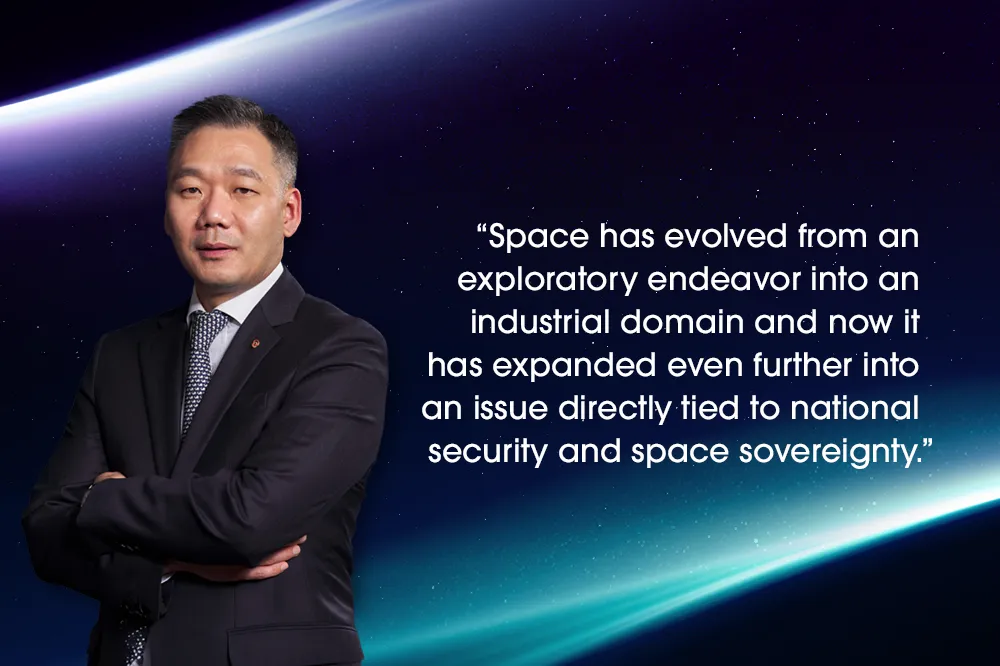
“Space has transitioned from exploration into the realm of industry,” says Kim, “and now it has expanded even further into an issue directly tied to national security and space sovereignty.”
Korea has moved to establish that independence, securing sovereign launch through the Nuri rocket program, with a next-generation reusable vehicle, the KSLV-III, in development.
d
What makes Hanwha’s VLEO position distinctive?
Sovereignty is only as meaningful as the orbital real estate a nation can access and sustain. Geostationary orbit, at roughly 36,000 kilometers, is saturated, and conventional low Earth orbit, around 500 kilometers, is crowded. VLEO offers measurable advantages over both: higher observation resolution, lower communications latency, and more precise navigation.
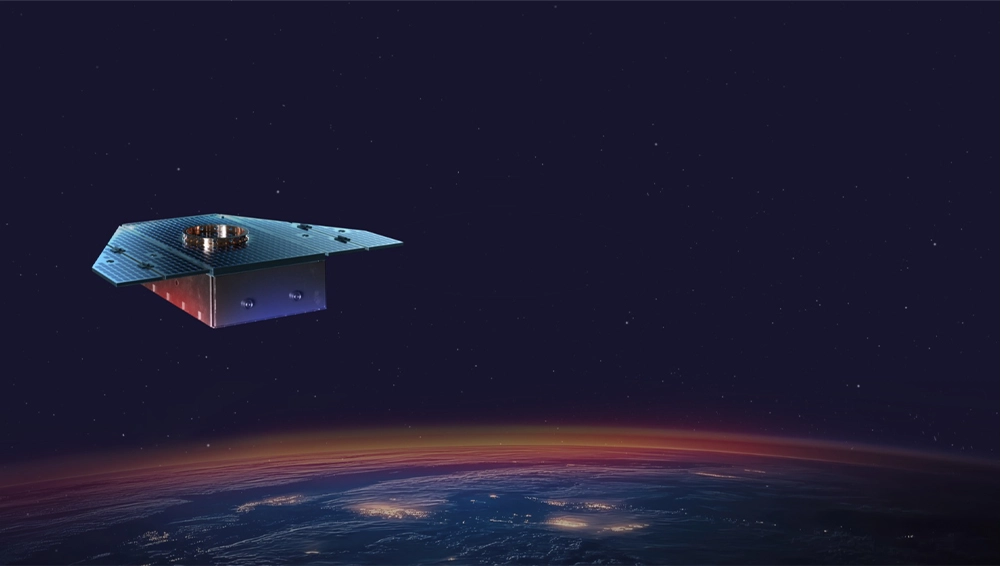
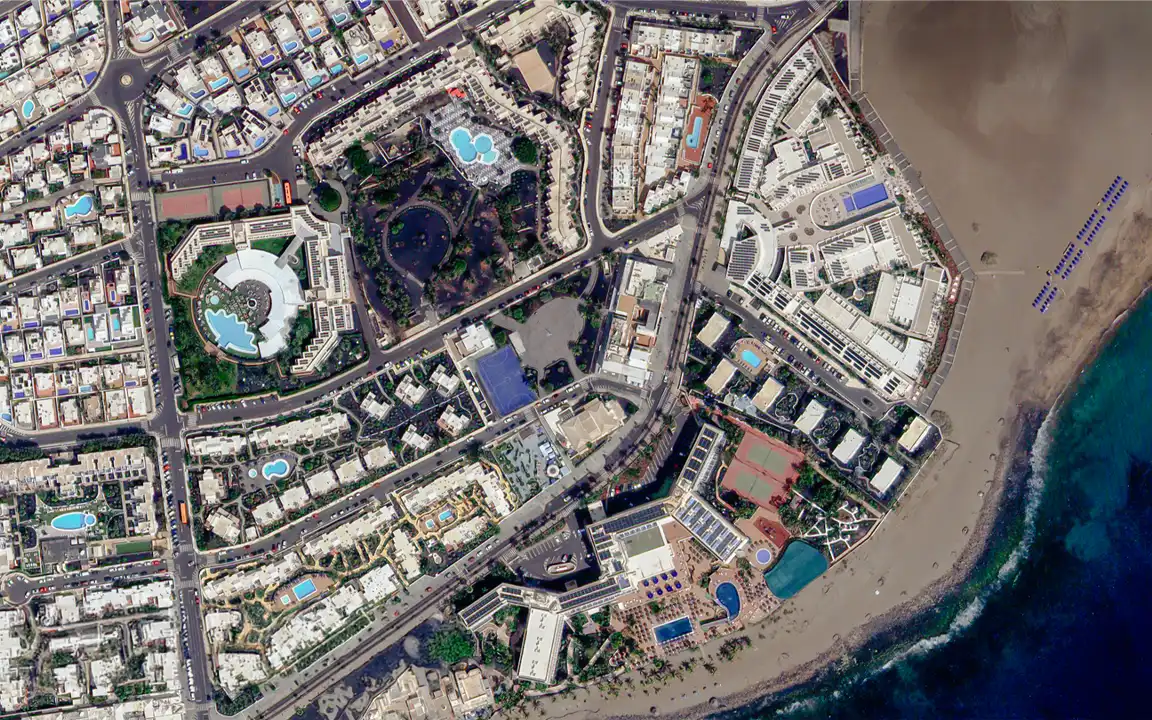
Hanwha is concentrating on Earth observation first, building a constellation led by synthetic aperture radar (SAR) and complemented by electro-optical (EO) satellites. The SAR satellites image the Earth at 10-centimeter-class resolution every 30 minutes, day or night and through cloud, sharper than the 25-centimeter commercial standard and refreshed far more often; the EO satellites add high-detail optical imagery in clear conditions. Operating that low is harder, because atmospheric drag and atomic-oxygen exposure wear on spacecraft, so Hanwha will begin with a test satellite near 500 kilometers and lower the orbit incrementally to gather data for future craft. “We aim to build the world’s first and best constellation in very low Earth orbit,” Kim says.
Building that constellation, however, requires more than satellites. It requires controlling every link in the chain that puts them there and keeps them useful.
d
How is Hanwha building an integrated space value chain?
Most space companies operate at one or two points along the value chain. Hanwha is assembling all of them. Hanwha Aerospace provides launch capability, Hanwha Systems develops the SAR satellites, and Satrec Initiative, in which Hanwha is the largest stakeholder, develops electro-optical satellites. The third pillar is analysis. “The true value does not lie in the images themselves, but rather in the interpretation of those images,” Kim says. Hanwha’s independently developed AI foundation model trains and infers directly from the imagery and lets users query it in plain language, the way they would a chatbot, turning raw data into faster, more accurate decisions for people who are not satellite specialists.
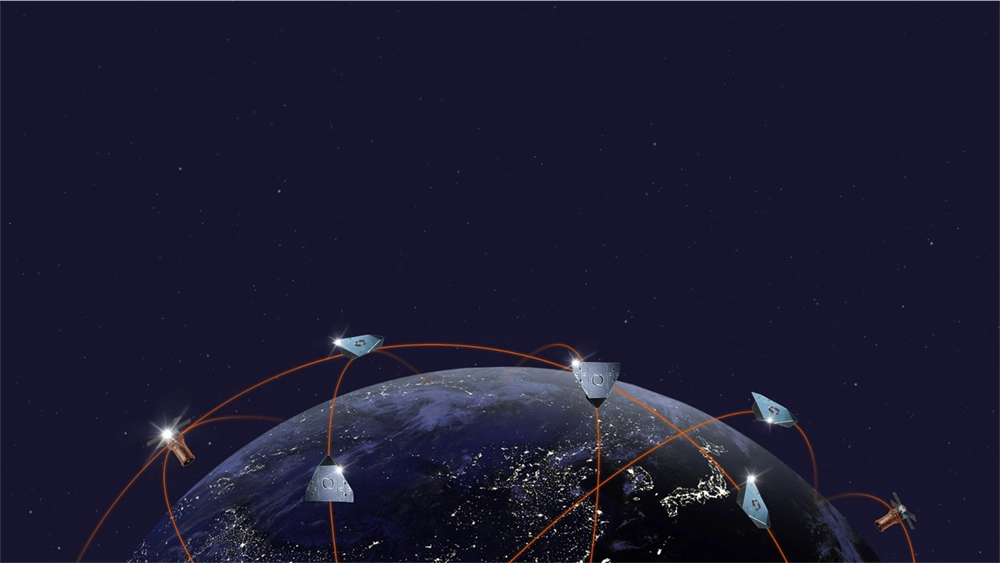
Integration also brings efficiencies, and several trace directly back to owning the launch system. Because Hanwha controls the rocket, it can design the launch vehicle and the satellites to fit one another: the satellites are built for its own fairings, and sovereign launch places them directly at 400 or 350 kilometers, sparing the months-long transfer from a standard 500-kilometer drop-off. The radar and optical satellites then fly in coordinated formations that single-modality constellations cannot match.
That combination of resolution, revisit rate, and fully integrated capability is designed to offer customers — in both defense and civilian sectors — services they have never experienced before.
What will the Space Hub mean for the New Space era?
At 10-centimeter-class resolution, the imagery has uses across defense and civilian life, from telling a real military vehicle from an inflatable decoy to Arctic sea-ice monitoring that could open shipping routes and shorten Asia-to-Europe voyages by 30% to 40%. Hanwha plans to deliver it through commercial contracts and an open data platform beyond government users. Around 70% to 80% of the technologies in Hanwha’s launch vehicles and satellites come from small and medium-sized enterprises and partner companies, Kim says, so the industry can only grow together. Keeping that ecosystem healthy depends on steady, predictable demand, which is part of why Hanwha is competing for global markets.
The Space Hub is Hanwha’s name for this integrated effort: the platform that ties its launch, satellite, and analysis businesses together with outside partners across the value chain, and from which those capabilities are meant to extend outward.
“Ultimately, customers will only need to tell us what they want to accomplish in space,” Kim says. “They will not need to worry about how to implement it. Space Hub will provide the solutions.”
Related Content


Get the latest news about Hanwha, right in your inbox.
Fields marked with * are mandatory.
- Non-employee
- Employee